

Indian Political System
Constitutional Framework
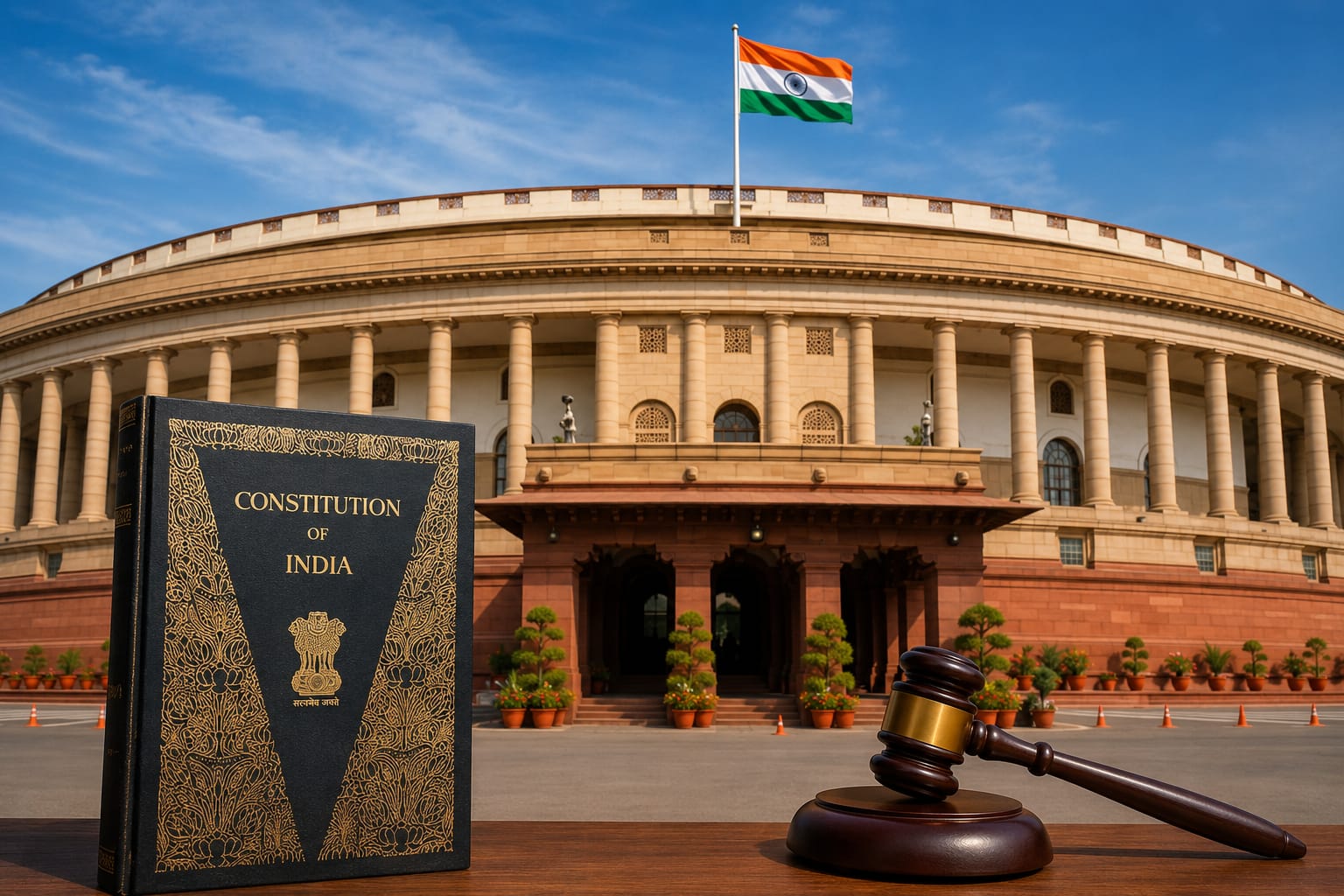
India is a sovereign, socialist, secular, democratic republic governed by the Constitution adopted on 26 November 1949, effective from 26 January 1950. It is the world’s lengthiest written constitution, containing 448 articles, 12 schedules, and over 100 amendments. The Constitution establishes the supreme law of the land, defining the structure, powers, and duties of government institutions while guaranteeing fundamental rights to citizens. It draws from multiple sources, including the British parliamentary system, the American federal structure, and the Irish directive principles. Dr. B.R. Ambedkar is regarded as its chief architect.
Federal Structure
India follows a quasi-federal system with a strong central government and 28 states plus 8 Union Territories. Power is divided through three lists — Union, State, and Concurrent — defined in the Seventh Schedule. While states have autonomy over subjects like law and order, agriculture, and public health, the Centre retains residuary powers. In times of emergency, the federal balance tilts heavily toward the Centre. Union Territories are directly administered by the Central Government, though some like Delhi and Puducherry enjoy partial statehood with elected legislatures.
The Executive
The Indian executive consists of the President, Vice President, Prime Minister, and the Council of Ministers. The President is the constitutional head of state, elected indirectly by elected members of Parliament and state legislatures. Real executive power, however, rests with the Prime Minister and Cabinet, who are collectively responsible to the Lok Sabha. The Prime Minister is the head of government and controls policy-making, administration, and appointments. The President acts on the advice of the Council of Ministers except in limited discretionary matters.
The Legislature (Parliament)
India has a bicameral Parliament consisting of the Lok Sabha (House of the People) and the Rajya Sabha (Council of States). The Lok Sabha has 543 elected members serving five-year terms, while the Rajya Sabha has 245 members — most elected by state legislatures and 12 nominated by the President. Parliament enacts laws, approves the national budget, and holds the executive accountable. Money Bills can only originate in the Lok Sabha. The Vice President of India serves as the ex-officio Chairman of the Rajya Sabha.
The Judiciary
India has an independent, integrated judiciary headed by the Supreme Court of India, established in 1950. Below it are 25 High Courts at the state level and district and subordinate courts at the grassroots. The Supreme Court serves as the guardian of the Constitution and the final court of appeal. It has original, appellate, and advisory jurisdiction. Judges are appointed by the President in consultation with a collegium of senior judges. Judicial review — the power to strike down laws violating the Constitution — is a cornerstone of India’s democratic system.
Political Parties
India has a multi-party system with two dominant national alliances: the National Democratic Alliance (NDA) led by the Bharatiya Janata Party (BJP) and the INDIA alliance led by the Indian National Congress (INC). Dozens of regional parties wield significant influence in states, often playing kingmaker roles in coalition governments. The Election Commission of India recognizes parties at national and state levels based on vote share and seat criteria. Coalition politics has been a defining feature since the 1990s, shaping policy through compromise and consensus among alliance partners.
Elections and the Election Commission
India conducts the world’s largest democratic elections, overseen by the Election Commission of India — a constitutional, independent body. General elections to the Lok Sabha and state assembly elections are held using the First-Past-the-Post (FPTP) system. The voting age is 18. The Election Commission enforces the Model Code of Conduct, manages voter rolls, and ensures free and fair elections. India’s 2024 General Election saw over 640 million votes cast, reaffirming its status as the world’s largest democracy. Electronic Voting Machines (EVMs) have been used since the 1990s.
Local Government
The 73rd and 74th Constitutional Amendments (1992) institutionalized local self-governance through Panchayati Raj Institutions (PRIs) in rural areas and Urban Local Bodies (ULBs) in cities. Gram Panchayats, Panchayat Samitis, and Zila Parishads form the three-tier rural structure. Urban bodies include Municipal Corporations, Municipalities, and Nagar Panchayats. One-third of seats in local bodies are reserved for women. Local governments handle development, sanitation, water supply, and public health at the grassroots level, making them vital instruments of participatory democracy and decentralized governance.
Fundamental Rights and Directive Principles
Part III of the Constitution guarantees six Fundamental Rights to all citizens — equality, freedom, protection against exploitation, freedom of religion, cultural and educational rights, and the right to constitutional remedies. Part IV outlines Directive Principles of State Policy, which are non-justiciable guidelines for the state to promote social and economic welfare. While Fundamental Rights are enforceable in courts, Directive Principles guide legislation and governance. The relationship between these two parts has been a major area of constitutional debate, notably in landmark cases like Kesavananda Bharati (1973).