


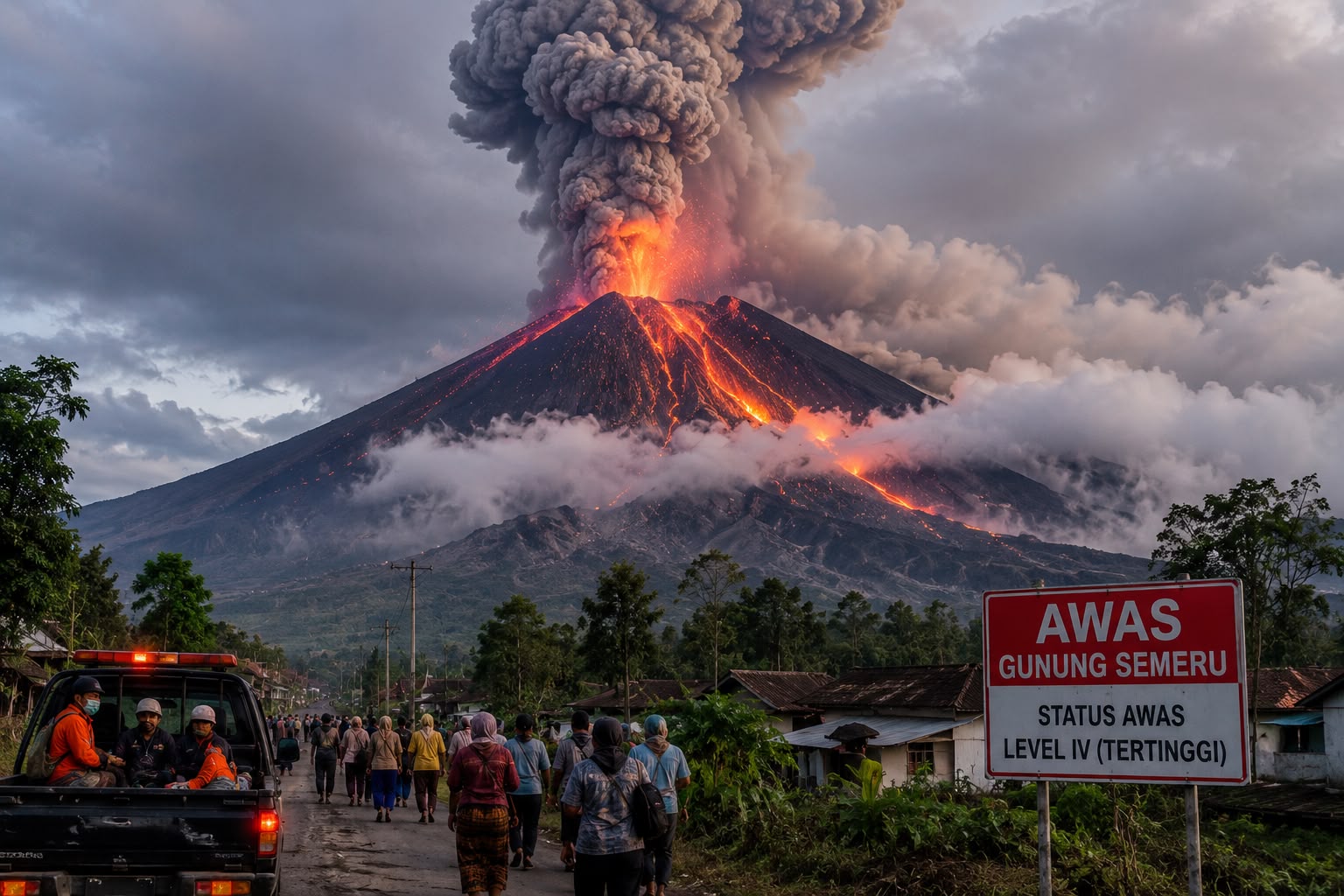
Indonesia has raised the alert level for Mount Semeru to its highest status following a significant increase in volcanic activity, prompting emergency measures and heightened monitoring efforts across parts of East Java. Officials say the volcano, one of Indonesia’s most active and closely watched peaks, has shown signs of escalating unrest, raising concerns about potential risks to nearby communities.
According to Indonesia’s geological and disaster management agencies, recent activity has included powerful eruptions, towering ash plumes, increased seismic activity, and the movement of volcanic material down the volcano’s slopes. Authorities reported that the decision to issue the highest alert level was based on a combination of intensified volcanic tremors, elevated gas emissions, and the potential for dangerous pyroclastic flows and lava movement.
Mount Semeru, standing at approximately 3,676 meters (12,060 feet), is located in East Java and forms part of Indonesia’s extensive volcanic chain. The volcano has erupted frequently throughout its recorded history and is known for producing ash clouds, lava flows, and deadly hot avalanches of volcanic debris. Previous major eruptions have caused fatalities, displaced thousands of residents, damaged infrastructure, and disrupted local economies.
In response to the heightened threat, authorities have expanded exclusion zones around the volcano and urged residents in high-risk areas to evacuate. Emergency shelters have been prepared, while disaster response teams remain on standby. Officials have also warned the public to avoid river valleys and channels that could carry volcanic debris during periods of heavy rainfall. Transportation authorities are monitoring conditions closely, and aviation officials have issued advisories regarding potential ash hazards to aircraft.
The increased volcanic activity has affected local communities, with some residents temporarily relocating to safer areas. Farmers, tourism operators, and businesses in the region are also facing uncertainty as authorities assess the evolving situation. Local officials have emphasized the importance of following evacuation instructions and remaining alert to updates from monitoring agencies.
Volcanologists explain that eruptions occur when pressure from rising magma and volcanic gases builds beneath the Earth’s surface. Monitoring systems around Mount Semeru track seismic activity, ground deformation, gas emissions, and thermal changes to help scientists assess eruption risks. While experts can identify warning signs, accurately predicting the timing and scale of volcanic eruptions remains challenging.
Researchers caution that conditions at active volcanoes can change rapidly. They note that elevated activity does not necessarily indicate a catastrophic eruption, but it does require constant observation and preparedness. Scientific teams continue to analyze incoming data around the clock to evaluate potential hazards and provide timely warnings.
Indonesia sits along the Pacific Ring of Fire, a vast zone of intense seismic and volcanic activity that makes the country one of the most volcanically active regions in the world. As a result, Indonesia has developed extensive monitoring networks and disaster preparedness systems to manage the risks posed by its numerous active volcanoes.
Authorities remain on high alert as Mount Semeru continues to show signs of unrest. Emergency services, scientists, and local governments are working together to protect communities while closely tracking developments at the volcano in the days ahead.